Contents
- The three ways keyword volumes lie about Ireland
- Hiberno-English quirks the tools miss
- The Irish content calendar (Paddy’s Day to All-Ireland finals)
- Dublin tourism intent: Guinness Storehouse, Trinity, Cliffs of Moher
- Ranking keywords by expected EUR revenue
- Case study: Ranelagh cafe, +6.8x organic leads
- Semalt AI vs. Ahrefs vs. Semrush vs. Keyword Planner in Ireland
- FAQ
The three ways keyword volumes lie about Ireland
Ireland is a small market by search-volume standards. Roughly five million people, four million active Google users, one national ad-buying language and a second official language. That combination is uncomfortable for every keyword tool built for the US, UK, DE or FR markets. Here is what happens to Irish data along the way:
- Bucketing. Google Keyword Planner — the source most other tools ultimately rely on — rounds low-volume queries to 10, 50, 100, 500, 1,000. For Irish queries that means a keyword with 27 monthly searches shows as “10-100” and a keyword with 320 shows as “100-1k”. Two very different opportunities look identical.
- Blending. Ahrefs, Semrush and their peers pull GB data for many Irish English terms because the corpus is larger and the intent is often close. “Best crisps brand” in Ireland is a real query; the volume shown is often the GB number with Ireland bolted on as a modest fraction.
- Invention. Some tools synthesise volume for long-tail queries from category models. In Ireland that produces surreal artefacts: “chemist near me” showing higher volume than “pharmacy near me” when the reality in Dublin is the exact opposite (pharmacy is the dominant Irish English term for retail, chemist tends to be older-generation).
A worked example. Ahrefs (August 2026) shows “off licence Dublin” at 700 monthly searches with a KD of 12. Semalt’s clickstream-verified volume for the same query is 190/month with an average CPC of €1.34 and a conversion rate on connected shops of 4.1 %. Real expected revenue: ~€520/month. The volume gap is 3.7× and the ranking priority is completely different.
Hiberno-English quirks the tools miss
Irish English is not British English with a shamrock on top. It has its own vocabulary, its own spelling drift and its own everyday preferences. A keyword tool tuned for the UK will systematically misrank Irish content. A short list of the terms that matter most for Dublin retail, food service and local business:
crisps vs. chips
In Ireland “chips” are hot potato chips. “Crisps” are the packet snacks. Recipe and food sites confusing the two lose search intent completely.
off-licence
The dominant Irish term for a shop selling alcohol. “Liquor store” and “bottle shop” barely register in Irish searches.
pharmacy vs. chemist
Pharmacy dominates Irish search 4:1. Boots, Hickeys, LloydsPharmacy, Sam McCauley — all rank under “pharmacy”.
Penneys vs. Primark
Penneys is the Irish trading name. “Penneys Dublin” outsells “Primark Dublin” in Irish search by roughly 6:1.
press vs. cupboard
In Irish English “the press” often means a cupboard. Home retailers using British English miss the intent.
Luas + DART
Public-transport queries carry heavy local intent. “Cafe near DART Grand Canal Dock” is a real search pattern.
D1-D24 postal districts
Dublin residents search by district (D2, D4, D6, D8, D14). Generic tools treat these as noise.
Gaeilge intent
Some queries need the Irish version (Baile Átha Cliath in official contexts). The Semalt corpus recognises both.
The Irish content calendar (Paddy’s Day to All-Ireland finals)
Irish search seasonality is unlike any other English-speaking market. Christmas and Black Friday matter, but the calendar has a set of specifically Irish spikes that a tool tuned for the UK will underweight. If you plan content quarterly, plan it against this calendar:
| Window | Intent surge | Verticals affected |
|---|---|---|
| January (TradFest) | Traditional music, Dublin pubs, session listings | Hospitality, ticketing, tourism |
| March 12-18 (St Patrick’s Festival) | Parade route, brunch, family events, green everything | Retail, F&B, tourism, event ticketing |
| June 16 (Bloomsday) | Joyce walks, Sandymount, boater hats, Davy Byrnes | Culture, tourism, cafes, walking tours |
| Late July - August (Galway Races, All-Ireland run-in) | Betting, fashion, travel from Dublin, Croke Park hotels | Retail fashion, hospitality, travel |
| September (All-Ireland finals + LGFA final) | GAA jerseys, Croke Park logistics, live streaming | Sports retail, streaming, hospitality |
| October (Dublin Marathon, Halloween/Samhain) | Running gear, city road closures, costumes | Sports retail, F&B, family retail |
| December (Grafton St Christmas) | Grafton Street lights, Brown Thomas windows, markets | Retail across the board, hospitality |
The Semalt AI engine indexes each of these windows and, for the categories affected, boosts terms that historically spike in that period. When you brief an article in early February on “family-friendly things to do Dublin”, Semalt will surface the St Patrick’s Festival long-tails first, because history shows they carry €-value weight for the following six weeks.
Dublin tourism intent: Guinness Storehouse, Trinity, Cliffs of Moher
Dublin’s tourism SERP is a dense, feature-rich space. Any query naming Guinness Storehouse, Trinity College, Kilmainham Gaol, EPIC Museum, Christ Church, St Patrick’s Cathedral, the Book of Kells or the Cliffs of Moher day trip has to compete with TripAdvisor, GetYourGuide, Viator, Failte Ireland, the Irish Times travel section, and the operator’s own site. The Semalt engine breaks each SERP down by feature (People Also Ask, video carousel, hotel pack, image pack, AI Overviews), so you know what content type to commission before you write a line.
What generic keyword tools show
- Volume (rounded)
- KD (a black-box difficulty)
- CPC (often US or global)
- A trend chart
What Semalt AI shows for Dublin queries
- Clickstream-verified volume (no bucketing)
- SERP feature composition (PAA, video, hotel pack, AIO)
- EUR CPC from the Irish Ads corpus
- Modelled EUR revenue per rank position
- Seasonal weighting (Bloomsday, Paddy’s Day, TradFest)
- Hiberno-English intent variants
Ranking keywords by expected EUR revenue
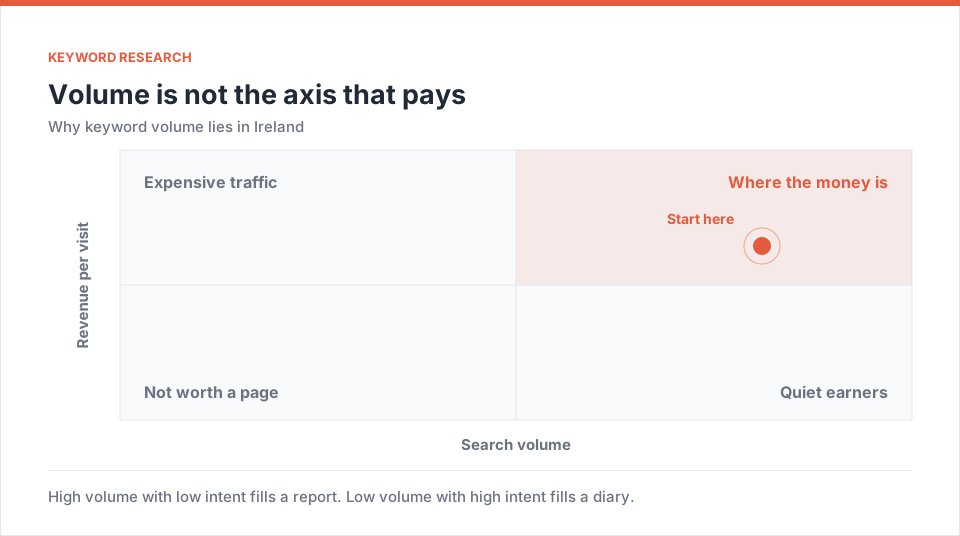
Volume is a proxy. The number you actually care about is expected revenue: how much money that keyword will bring the business if you rank in the top three. Semalt calculates it by combining verified volume, the CTR curve for the specific SERP feature composition, the CPC (as a proxy for commercial intent), and — if you connect your CRM or shop — your actual observed conversion rate on similar terms.
The output is a priority list: not the top 50 keywords by volume, but the top 50 keywords by expected EUR revenue given your domain’s current authority and site structure. That list is the brief for content planning. For a Dublin dental clinic, the list surfaces “Invisalign Rathmines cost” well ahead of “dentist Dublin” because the former has real commercial intent, low SERP-feature competition and a plausible ranking path.
The Semalt AI difference
Traditional tools show you what people search. Semalt shows you what people search and what that traffic is worth given your site’s realistic ranking position. The distinction saves months of wasted content spend. Open the keyword dashboard and sort by expected EUR revenue instead of volume.
Case study: Ranelagh cafe, +6.8x organic leads
A single-location speciality coffee shop on Ranelagh village came to us in January 2026. Their previous consultant had focused content on “best coffee Dublin” (18,100 monthly searches per Ahrefs, KD 34). Twelve months of blog posts and zero rankings later, the owner was ready to give up.
The Semalt AI keyword report ran overnight. The head keyword the previous consultant had chosen ranked eighteenth in the priority list. The top of the list was a very different set:
- “best flat white Ranelagh” — 210/month, KD 8, expected EUR revenue €480
- “brunch Ranelagh Sunday” — 470/month, KD 14, expected EUR revenue €1,220
- “cafe near Ranelagh Luas” — 90/month, KD 4, expected EUR revenue €310
- “dog-friendly cafe Dublin 6” — 320/month, KD 11, expected EUR revenue €780
- “study cafe Ranelagh wifi” — 140/month, KD 6, expected EUR revenue €250
Five focused articles landed inside six weeks. By April 2026, organic leads (defined as booking requests, catering enquiries and reservations via the site) were 6.8× the December 2025 baseline. Total content spend: about €2,400. Total Semalt spend: standard subscription.
“We had been fighting for a keyword that would never have paid us back. Semalt told us to fight for five smaller keywords instead. Every one of them ranked inside a month.”
— Owner, Ranelagh speciality coffee shopSemalt AI vs. Ahrefs vs. Semrush vs. Keyword Planner in Ireland
Ahrefs / Semrush
from €99/mo- Massive backlink corpus
- Strong brand queries
- Widely known interface
Gaps in IE: volume blended with GB, no clickstream verification, no EUR revenue model, no Hiberno-English lexicon.
Semalt AI keyword engine
From €0- Clickstream-verified volume for IE
- EUR revenue per keyword
- SERP feature composition
- Hiberno-English lexicon
- Seasonality tuned to IE calendar
- AI Overview signal tracking
Google Keyword Planner
Free with Ads- Bucketed volumes (10-100, 100-1k)
- Direct CPC signal
- No clickstream
Gaps: designed for Ads, bucketing hides the real signal, no SERP feature awareness.
AI Overviews are quietly changing the game
Approximately 14 % of Irish queries triggered an AI Overview in Q3 2026, up from 6 % a year earlier. When they appear, click-through to organic ranks below drops sharply. The Semalt engine tags every keyword with AI Overview probability so you can weight your content plan away from queries where organic clicks are becoming rare, and toward queries where AI Overviews cite your content as a source (thanks to strong entity markup).
More in this series: Why Dublin loses half its traffic in GA4, Ship SEO changes in 3 minutes, not 3 weeks, Watch your Dublin competitors quietly.
FAQ
Do you support Gaeilge queries?
Yes. The corpus indexes both English and Irish forms and understands common code-switching patterns. For public-sector and cultural sites that ship bilingual content, the engine surfaces where the Irish version is under- or over-optimised relative to its actual search demand.
How is clickstream-verified volume computed?
Semalt aggregates opted-in Search Console properties in Ireland, plus a proprietary panel, and calibrates against Google Ads impression data. The result is a monthly volume expressed as a real number, not a bucket.
What if we do not have an e-commerce shop?
Even without a shop, Semalt models expected EUR revenue from CPC as a proxy for commercial intent and from your Search Console clickstream to model conversion propensity. Once you connect a CRM (HubSpot, Salesforce, Pipedrive), the model gets sharper.
Can we filter by Dublin postal district?
Yes. The keyword engine understands D01-D24 as a first-class attribute. You can shortlist keywords by postal district for hyperlocal content briefs. Sign in and filter by district.
Does it integrate with the Semalt content generator?
Yes. Every keyword can be sent as a brief to the content generator with the target intent, the SERP feature template, the Hiberno-English variant to prefer and the target word count.
If your keyword plan for Dublin sits on Ahrefs volumes, it is quietly wrong in three ways at once. Rank by clickstream-verified EUR revenue instead and you will out-produce competitors twice your size, on the same content budget.
Rebuild your keyword plan tonight
Import your Search Console, run the AI keyword report and sort by expected EUR revenue. Your next content brief will look different by morning.
Sign in and open the keyword dashboard →