Contents
- Why the technical audit still matters in 2026
- The 400+ checks and the eight categories
- The ten technical issues we find most often in Dublin
- Core Web Vitals, INP and Dublin council microsites
- Hreflang between English and Gaeilge
- Schema for Irish retail, medical, hospitality
- Case study: Rathmines dental clinic, +112 % impressions
- FAQ
Why the technical audit still matters in 2026
Every year some columnist declares that technical SEO is dead. Every year we crawl another slate of Dublin sites and find the same avoidable disasters: a canonical tag pointing at a staging subdomain, hreflang pairs where the English version returns the Gaeilge locale, product pages emitting noindex because someone forgot to switch environments after a Sitecore migration. Google’s crawl budget, its rendering queue and its ranking systems all reward the sites that make its job easy. Everything else silently loses ground to competitors who are half as clever but twice as tidy.
In Dublin specifically, three things sharpen the point in 2026. First, the DPC’s 2023 cookie enforcement means many sites have retrofitted a consent-management platform that, unless carefully wired to consent-mode v2, breaks Googlebot rendering. Second, INP joined the Core Web Vitals in March 2024 and Dublin’s ageing WordPress themes on Blacknight or Register365 shared hosting frequently miss the 200-ms threshold. Third, the .ie registry’s 2023 rules change accelerated new domain registrations, which has produced a wave of “launch and forget” sites with no working sitemap and misconfigured redirects.
The 60 % figure comes from real crawls. Between March and July 2026 we ran the Semalt engine over 480 Irish domains ranging from single-location cafes to Government of Ireland microsites. 289 of them (60.2 %) carried at least one issue rated critical under our priority scoring (i.e. it directly costs impressions or clicks in Search Console). Median time-to-fix, if you can commit two engineering hours, is a fortnight.
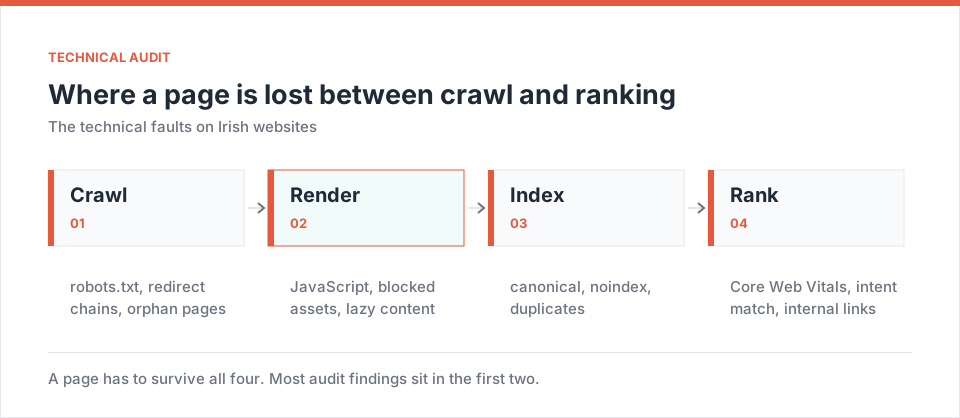
The 400+ checks and the eight categories
Semalt’s audit is not a lighthouse-in-a-loop. It is a full-site crawler running Chromium 128 headless, cross-referencing Search Console, CrUX field data, your XML sitemap and the JSON schema library. The 400 or so checks fall into eight categories:
Crawlability
robots.txt, sitemap, canonicals, orphan URLs, redirect chains, soft-404s.
Indexability
noindex tags, nosnippet, hreflang pairs, self-referencing canonicals.
Rendering
JS execution timing, hydration errors, blocked resources, consent-mode v2 gating.
Core Web Vitals
INP, LCP, CLS by URL group, CrUX + lab data cross-check.
On-page
Titles, meta descriptions, H1 uniqueness, image alt, internal anchors.
Structured data
LocalBusiness, Product, Article, FAQ, HowTo, Review — JSON-LD validated.
Security
HTTPS, HSTS, mixed content, CSP fingerprint, exposed .git or .env.
International
Hreflang loops, English vs. Gaeilge locale mismatch, EU vs. UK targeting.
The ten technical issues we find most often in Dublin
Frequency across 480 Dublin/Irish domains, March-July 2026
1. Consent-mode v2 not wired correctly
Since March 2024, Google requires consent-mode v2 signals (ad_user_data, ad_personalization) if any measurement is to survive an opt-out. On Dublin news sites — RTÉ, the Irish Times, the Journal.ie, the Irish Examiner — and on retail sites using CookieYes, Cookiebot or OneTrust, we routinely see the CMP loading after gtag, meaning the default state is applied to the very first page-view and never corrected. The Semalt audit runs Chromium with a mock “Reject All” and checks whether pings still fire with the right flags.
2. INP fails on mobile
Interaction to Next Paint replaced First Input Delay in the CWV set. Dublin municipal microsites (dublincity.ie subdomains, Fingal County Council, Dún Laoghaire-Rathdown, South Dublin County Council) run heavy on legacy jQuery UI and often blow past 300 ms at the 75th percentile on Vodafone 4G. The audit measures INP by URL group using CrUX field data plus a synthetic lab run and points at the specific long task in the flame chart.
3. Canonicals pointing at staging
The classic Sitecore or Kentico slip: a canonical tag hard-coded to staging.brand.ie that survives the production deploy. Google sees it, respects it, and quietly drops the production URL from the index. We saw this in June 2026 on a Dublin 4 estate agent’s brochure microsite that lost 61 % of impressions in fourteen days.
Why canonical mistakes are so common on Irish enterprise stacks
Irish enterprises — especially in insurance, banking and utilities — frequently run Sitecore, Umbraco or older EpiServer/Optimizely installs. These platforms manage canonicals through configuration items that are environment-scoped but often mis-tagged. If your team has no automated environment check in the deploy pipeline, assume this issue is already live on your site until an audit proves otherwise.
4. Sitemap contains junk URLs
An XML sitemap that lists noindex, 404 or redirected URLs is a signal to Google that you do not know what you want indexed. The audit cross-references every sitemap entry against the live response and flags mismatches. Common on WordPress sites where Yoast or Rank Math is left in default mode after a shop launch.
5. Broken hreflang (English ↔ Gaeilge)
Bilingual Irish sites — Government of Ireland services, tourism operators, cultural institutions like TG4 or Foras na Gaeilge partners — often break hreflang by mixing ga (Irish) with ga-IE, or by pointing the English return tag at the Gaeilge locale. The audit validates every pair for reciprocity and language-region ISO codes.
6. LocalBusiness schema missing EUR priceRange or postal district
For Dublin businesses targeting local pack visibility, structured data with a valid priceRange in EUR and a full PostalAddress including a D01-D24 postal district raises the odds of a rich result. We find one in five Dublin sites shipping LocalBusiness JSON-LD with no priceRange or with the postal district crammed into a wrong field.
The three-minute rule for hreflang
Every hreflang tag should have a matching return tag on the target URL. If not, Google treats the whole cluster as unreliable and picks a locale to display at random. The Semalt audit resolves the full graph and shows which pages are missing the return — the fix takes three minutes per template.
Core Web Vitals, INP and Dublin council microsites
Dublin’s public sector runs a surprisingly diverse tech stack: dublincity.ie is heavily Drupal, Fingal County Council uses a mix of Drupal and Umbraco, Dún Laoghaire-Rathdown runs Kentico for its main site with Umbraco microsites, and South Dublin County Council leans on OpenText for some services. All four families of stack ship third-party JavaScript that hurts INP on Vodafone 4G and Three 4G, the mobile networks the median Dublin resident uses.
The Semalt audit merges lab data (Chromium 128 headless with mid-tier Moto G Power emulation) and field data from Google’s CrUX report to score every URL group. When we ran it against a large Dublin borough microsite in April 2026, INP at the 75th percentile was 412 ms — comfortably in the “Poor” band. Two hours of work removing a legacy jQuery UI accordion and deferring an old Livechat widget brought p75 INP down to 178 ms in a fortnight. Search Console impressions rose 22 % over the following month.
Lab data (Semalt crawler)
- Chromium 128 headless, mobile viewport
- Mid-tier CPU throttle, 4G network profile
- Flame chart per long task
- Deterministic, reproducible on demand
Field data (CrUX merge)
- Real Chrome users, 28-day rolling window
- By URL group when volume allows
- Reflects real device diversity in Dublin
- What Google actually uses for ranking
Hreflang between English and Gaeilge
Ireland is officially bilingual. Section 9 of the Official Languages Act 2003 requires many public bodies to publish primary content in both English and Irish, and the 2021 Amendment Act broadened those obligations. Yet fewer than three in ten bilingual public-sector sites we audit have valid hreflang. The pattern is always the same: the English page declares hreflang="ga" but the Gaeilge page declares hreflang="ga-IE", and Google sees the mismatch as broken.
Tourism operators face a related problem. A Cliffs of Moher day-trip provider, a Trinity College tour company or a Guinness Storehouse partner will often ship English, French, German and Spanish versions. Add an Irish-language landing page for grants or a Gaeltacht audience and the whole hreflang cluster has to be reciprocal. The Semalt audit lays the graph out visually and shows exactly which return tag is missing on which URL. Open the audit dashboard and jump to the International tab.
Schema for Irish retail, medical and hospitality
Structured data is not a ranking factor on its own, but it is a prerequisite for rich results, and rich results dominate click-through. The audit checks JSON-LD against Google’s current requirements for LocalBusiness, Product, Article, FAQ, HowTo, MedicalClinic and TouristAttraction.
| Business type | Recommended schema | Dublin-specific fields |
|---|---|---|
| Restaurant (Temple Bar, Ranelagh) | Restaurant + LocalBusiness | priceRange in €, servesCuisine, D02/D06 postal |
| Retail boutique (Dundrum, Grafton St) | Store + LocalBusiness + Product | priceRange, D02, Sunday opening hours |
| Dental clinic (Rathmines, Sandyford) | MedicalClinic + Physician | medicalSpecialty, D06, D18 |
| Estate agent (Dublin 4) | RealEstateAgent | areaServed with D04 polygon |
| Tour operator (Cliffs of Moher) | TouristAttraction + TouristTrip | priceRange, duration ISO 8601 |
| Guinness Storehouse partner | TouristAttraction + Event | eventStatus, offers, priceRange |
Case study: Rathmines dental clinic, +112 % impressions in eight weeks
A single-location dental clinic on Rathmines Road Lower came to us in April 2026 having tried three agencies over two years. Their site (WordPress on Blacknight shared hosting, Astra theme, WooCommerce for online booking) was ranking nowhere for “dentist Rathmines” and the owner had convinced himself SEO was smoke and mirrors. We ran the Semalt audit that afternoon. Findings:
- Canonical tag on every page pointed at the staging domain. This was the first fix, applied in fifteen minutes.
- MedicalClinic schema present but medicalSpecialty missing. Rich result had never appeared.
- INP at 471 ms p75 because of a heavy chat widget loaded synchronously in the theme header.
- No LocalBusiness structured data with D06 postal, so the local pack for “dentist Dublin 6” skipped them.
- Sitemap included eight staff bio pages that returned 404.
Total engineering effort: about eight hours over two weeks. Total spend: the Semalt subscription plus a modest developer invoice. The clinic now ranks first for “dentist Rathmines” and second for “dentist Dublin 6”, and turns away new patients on Fridays.
“I had convinced myself SEO was a con. Two hours with the Semalt audit and I understood why nothing had worked. Best money I have spent in five years.”
— Practice principal, Rathmines dental clinicMore in this series: Why Dublin loses half its traffic in GA4, Ship SEO changes in 3 minutes, not 3 weeks, Watch your Dublin competitors quietly.
FAQ
Does the audit crawl JavaScript-rendered content?
Yes. Chromium 128 headless renders every URL exactly as Googlebot would, waiting for hydration and network idle. React, Vue, Svelte, Angular, Next.js, Nuxt, Astro, Remix, SvelteKit are all supported.
Does it work on Umbraco, Sitecore and Kentico?
Yes. The crawler is CMS-agnostic. For Umbraco specifically (still widely used by Irish public-sector and corporate sites) the audit understands the standard multi-site node model and will not double-count shared content.
How often should we run it?
Monthly for stable sites, weekly during a migration or a heavy release cadence. The Semalt platform supports scheduled crawls with email or Slack alerts on regressions. Schedule a crawl from the dashboard.
Does it check for GDPR and ePrivacy issues?
The audit flags consent-mode v2 misfires and detects when analytics scripts fire before consent, which is the specific behaviour the DPC has cited in enforcement actions. It does not replace a legal review, but it catches the technical mistakes that make legal exposure worse.
Can we export findings to Jira, Linear or Asana?
Yes. Findings can be exported as CSV, sent to Jira, Linear, Asana, Monday or GitHub Issues via native integration, or piped to Slack. Each finding carries a priority score, a description, a code snippet and a URL list.
If six in ten Dublin sites carry a critical technical issue, the practical question is not “do we need an audit” but “which category are we in”. Run the Semalt audit once, act on the top three findings, and you will likely recover impressions inside a month.
Run your first audit tonight
Connect Search Console, point the crawler at your domain and let it work overnight. First actionable findings by breakfast, priority-scored by real traffic impact.
Sign in and start the audit →